


Sunday Scaries: Why High Achievers Experience Sunday Night Anxiety. And How to Manage It
- Suzy Hunt

- May 14
- 4 min read
Sunday Scaries: The Burnout Warning Many High Performers Ignore
If you’ve ever felt anxious, overwhelmed, emotionally flat, or restless on a Sunday evening, you’re not alone.
For many professionals, the “Sunday Scaries” begin long before Monday morning. A racing mind, difficulty relaxing, overthinking the week ahead, or feeling emotionally drained before work has even started again are all common signs.
After more than 20 years coaching executives, business owners, and high-performing professionals, one thing has become consistently clear: The Sunday Scaries are rarely just about Mondays.
They’re usually a sign that stress has been building for too long without enough recovery.

What Does Sunday Scaries Mean?
The term “Sunday Scaries” describes feelings of anxiety, dread, stress, or low mood that appear on Sundays as the work week approaches.
For some people it’s mild. For others, it can feel overwhelming and become part of a weekly cycle linked to:
Workplace stress
Burnout
Overthinking
Poor work-life balance
Leadership pressure
Anxiety before work
Emotional exhaustion
While anyone can experience Sunday night anxiety, it’s especially common among ambitious professionals and high achievers who struggle to fully switch off.
Why Do People Get Sunday Scaries?
There’s rarely one single cause.
In my experience as an executive coach, Sunday anxiety is usually created by a combination of pressure, mental overload, and lack of recovery.
Common causes include:
Constant responsibility
Fear of failure
Unrealistic workloads
Leadership pressure
Workplace conflict
Decision fatigue
Poor boundaries with work
Chronic stress
Feeling emotionally exhausted
Many professionals stay mentally “on” all weekend. By Sunday evening, the nervous system is already anticipating pressure before the week has even begun.
The One Executive Coaching Technique I Recommend Most
One of the most effective techniques I’ve shared with coaching clients over the years is something I call:
Control, Influence, Release
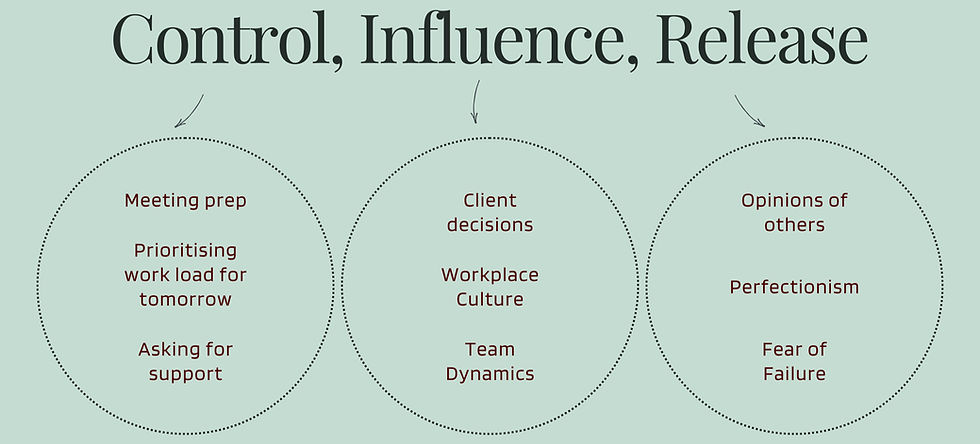
Most Sunday night anxiety comes from trying to mentally carry everything at once.
Before bed on Sunday evening, divide a page into three columns.
1. What Can I Control?
Write down the things you can directly act on.
For example:
Preparing for a meeting
Prioritising tomorrow’s workload
Asking for support
Taking proper breaks
2. What Can I Influence?
These are situations you can contribute to, but not fully control.
Examples include:
Team dynamics
Client decisions
Business outcomes
Workplace culture
3. What Do I Need to Release?
This is often the most important category.
Write down the things your mind is carrying that are outside your control:
Other people’s opinions
Worst-case scenarios
Perfectionism
Fear of failure
Monday catastrophising
This exercise helps separate genuine responsibility from unnecessary mental pressure.
And often, that clarity alone can calm the nervous system significantly.
What Is the 3-3-3 Rule for Anxiety?
Another helpful technique for overthinking and anxiety is the 3-3-3 rule.
When your mind starts spiralling:
Name 3 things you can see
Identify 3 sounds you can hear
Move 3 parts of your body
This grounding exercise helps bring your attention back into the present moment instead of focusing on future stress.
How to Calm Down Before Work
If you regularly feel anxious on Sunday evenings, these small changes can make a big difference.
Create a Calmer Sunday Evening Routine
Your nervous system responds well to predictability.
Try:
Going for a walk
Stretching or yoga
Journaling
Reading instead of scrolling
Meal prepping for the week
Reducing screen time
Going to bed earlier
Stop Checking Work Emails
One of the biggest triggers for Sunday night anxiety is staying psychologically connected to work.
Creating stronger boundaries around emails, notifications, and work conversations can help your brain properly recover.
Challenge Overthinking
Ask yourself:
Am I preparing or catastrophising?
What is actually within my control?
What evidence do I have that this week will be unmanageable?
Often, anxiety grows when the brain treats imagined scenarios as facts.
Sunday Scaries vs Burnout
Occasional Sunday anxiety is normal. But if the Sunday Scaries happen every week, burnout may be developing.
Common burnout symptoms include:
Emotional exhaustion
Constant fatigue
Irritability
Brain fog
Lack of motivation
Feeling detached from work
Difficulty concentrating
Increased anxiety
Burnout is not a sign of weakness.
It’s usually a sign that someone has been operating under pressure for too long without enough recovery.
The Sunday Scaries are not something to feel embarrassed about.
They’re often valuable feedback.
A sign that your current pace, pressure, or way of working may no longer be sustainable.
After 20 years in executive coaching, I’ve seen how many successful people silently normalise stress and emotional exhaustion.
But high performance should never come at the expense of your wellbeing.
You can still be ambitious, driven, and successful while creating healthier boundaries, calmer routines, and a more sustainable way of working.
Sometimes the most important question isn’t:
“How do I push through this?” but rather, “What needs to change so success feels healthier again?” That’s often where meaningful change begins.
Resonate with any of the above? Perhaps it's time to reach out for some support as you overcome the Sunday Scaries. Why not book a complimentary 30 minute chat with me to uncover what's going on!



Comments